
New in Warsaw and know nobody? A realistic first month
Short version: Warsaw has more free social infrastructure than almost anyone new here uses, and the thing standing between you and a circle is usually not language, money or Poles. It is that you keep going to things once.
The first few weeks after moving are busy enough to hide the problem. Paperwork, a flat, a PESEL number, the correct tram. Then the admin runs out, and a Saturday arrives with nothing in it.
You are in good company statistically. Poland's statistics office ran an experimental count of who is actually present in Warsaw and put it at about 2.075 million people at the end of 2025, roughly 301,000 of them foreigners, about 14.5% of the city (GUS, via Notes from Poland). The city has 262,700 students, and 33,900 of them are foreign, led by Ukraine, Belarus, Turkey and India (Informator Stolicy). Tens of thousands of people in this city are having the same September you are having.
We surveyed 83 of them between 29 August and 7 September 2026, most in and around Warsaw. Here is what their answers suggest you actually do.
The blocker is not the city and not the language
We asked what gets in the way of meeting people you click with.
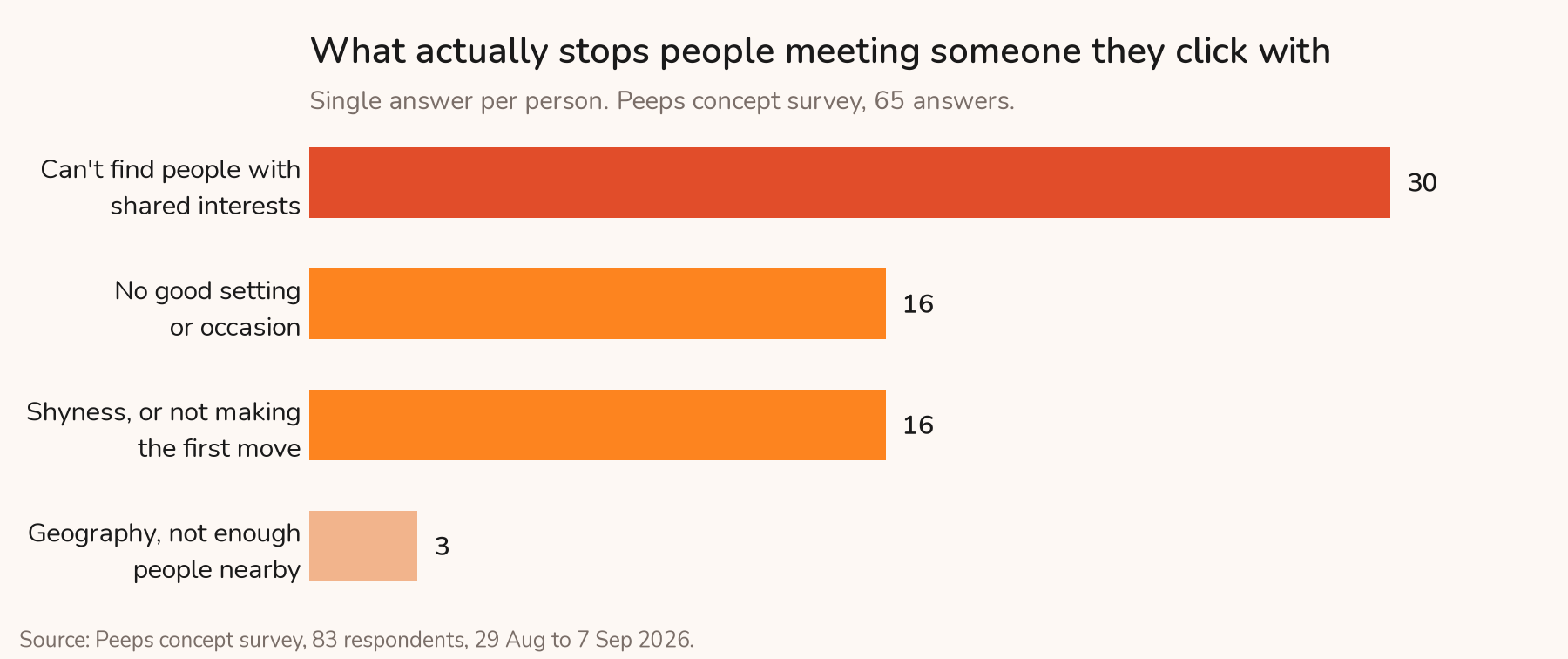
Thirty said they cannot find people who share their interests. Sixteen said there was no good setting or occasion. Sixteen said shyness, or not wanting to make the first move. Three said geography.
Three people out of 83 thought the problem was distance, in a city where you can cross from Wola to Praga in half an hour. Eighty percent of those who answered said meeting people they click with is somewhat hard, hard or very hard. Only four called it effortless.
So the difficulty is real, but it is not about supply. It is about the absence of a repeated occasion where the same faces appear. You get that at work by accident and almost nowhere else.
Where people are looking now, and why it is not working
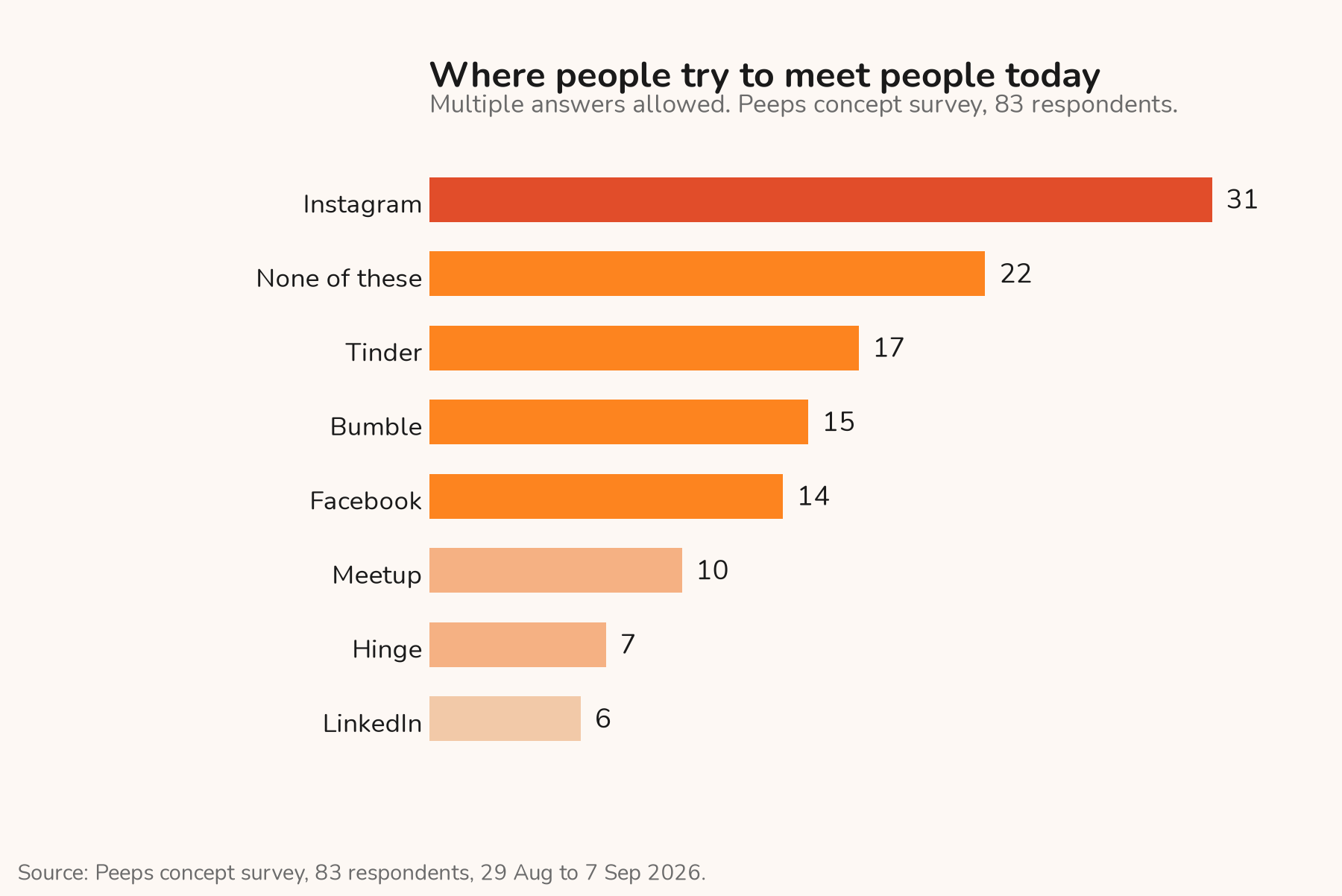
Instagram was the most common answer at 31. Then, remarkably, "none of these" at 22. Tinder 17, Bumble 15, Facebook 14, Meetup 10, Hinge 7, LinkedIn 6.
Two things stand out. The largest real channel is a broadcast feed nobody joined to make friends on, and the second largest group is people not using any of the apps we listed. That can mean VK, Telegram groups, word of mouth, or another channel we did not include. Meetup, the platform explicitly built for this, was named by 10 out of 83.
That gap is your opportunity, because the meetups in this city are not short of events. They are short of people who show up more than once.
What already exists here, and what it costs
Before you invent anything, use what is here. Just check the price tag first, because the two platforms everyone recommends to newcomers are not really free.

- InterNations Warsaw is the big one, with more than 25,000 members, around 19 events a month and 32 hosts (InterNations). The basic account is free, but the events you want tend to need Albatross membership at roughly 10 to 15 euros a month, and there is often a cover charge on top (InterNations membership). Paying a subscription to find out who is in a bar is a peculiar expense in month one.
- Meetup hosts most of the rest of the city's groups, including Warsaw International with thousands of members (Meetup). Organisers pay Meetup a recurring fee, so a lot of groups charge around 35 PLN at the door to break even (Warsaw International Network). Useful to know so you can tell a fair ticket from a mixer that is monetising a crowd.
- Meet & Speak is the genuinely free option, with five or more events a week, including a Saturday language and flag party that regularly draws a couple of hundred people (Meetup). The softest possible landing if your Polish stops at "dzień dobry".
Then there is everything that is not marketed as social at all, which is where most of my own friendships here came from. Bouldering at Murall or Blocalna, where you end up talking to strangers because you are all failing at the same route. Sunday runs along the Wisła and the parkrun loop in Praga. Board games at Południk Zero. Football and volleyball pickups that fill by Thursday. Ceramics and cooking classes. Volunteering, which is the most underused option in the city.
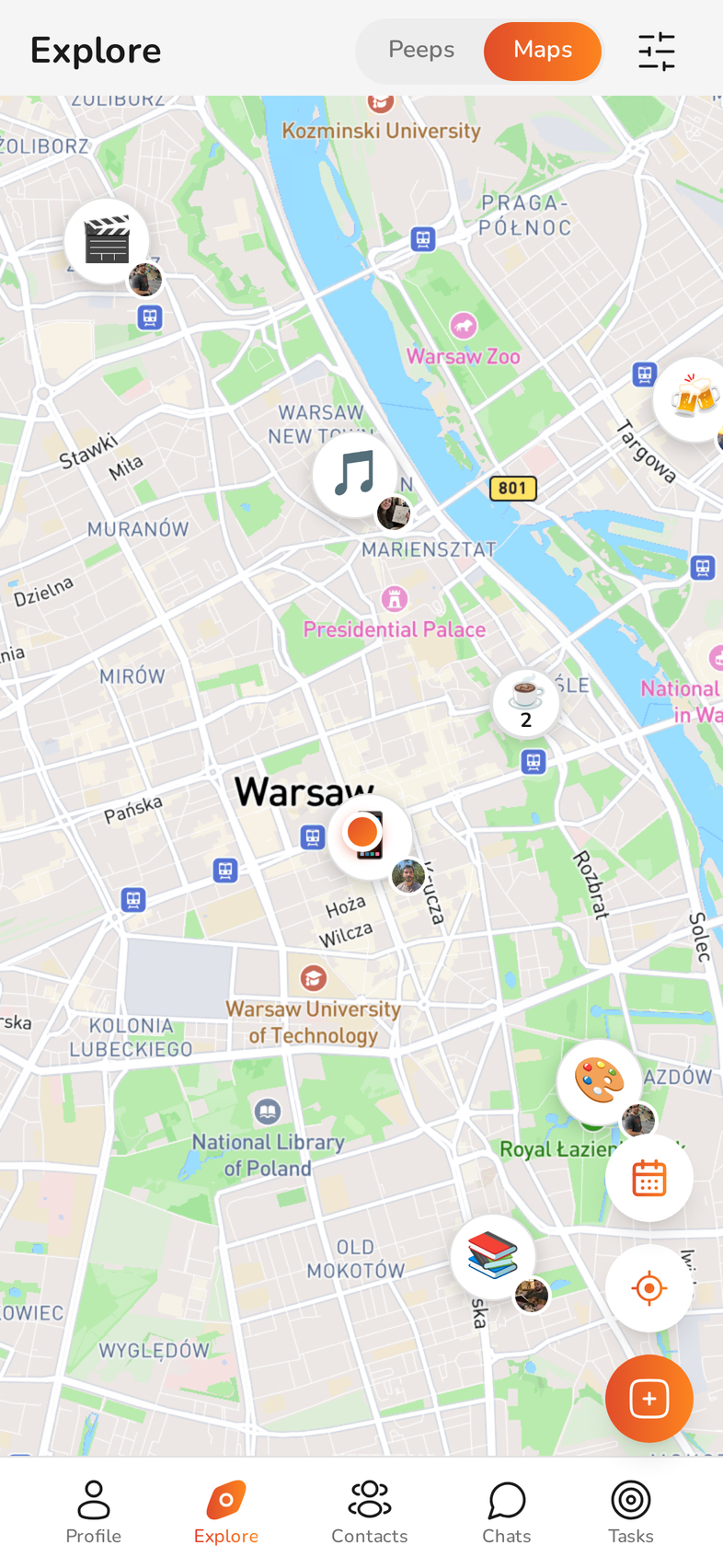
Interest first, people second. That order does the filtering the survey says people cannot do on their own. It also keeps the money honest: you pay for a wall, a court or a kiln, not for permission to stand near other members. Peeps works the same way, and everyone who signs up during the beta keeps free access for good.
Language, honestly
Warsaw is genuinely workable in English, especially in Śródmieście, Wola and Służewiec offices, and the international meetups run in English by default. So English will get you a social life.
Polish will get you a different one. Even 50 words changes how a Saturday goes: you can order, joke badly, and stop being the person the group switches languages for. A language exchange is the most efficient version of this, because it is the one room where being bad at a language is the entry ticket rather than an embarrassment. Semrush shows people search "language exchange warsaw" roughly 70 times a month, which is small, and roughly 70 more than the number of people who then go twice.
Money, honestly
If you are new here, your budget is probably tight. Average pay in the Warsaw enterprise sector was 11,185 PLN gross in June 2026, but that figure describes established professionals, not someone in their first junior role (GUS Warsaw). Median total housing cost sits around 4,226 PLN a month, with a room share nearer 1,400 (Passflat).
You do not need to spend anything to fix this. The free tier of Warsaw's social life is large. When you do pay, pay for a thing rather than for access: a class, a court, a tasting, a ticket with a drink in it. That distinction shows up in our survey too, where 12 of the people who quit dating apps named paywalls as a reason.
The plan for your first four weeks
Week one. Pick two recurring free events that match something you already like, not something you think you should like. Put both in your calendar twice. Not once. Twice.
Week two. Go to both, and go alone. This is easier than it sounds at a language exchange or a flag party, where arriving alone is the norm and everybody is doing the same thing. Talk to three people. Do not try to make friends. Try to have three conversations.
Week three. Go back to the same two events. Nobody does this, and it is the part that works. Your second appearance is when the regulars place you, and being placed is worth more than any conversation you had on the first night.
Week four. Propose something specific to two people you got on with. Not "we should hang out sometime". A place, a day, a time, and a reason. In our survey 18 people said meetings never happen because the chat fizzles first, and 32 admitted they move a new conversation to WhatsApp or Telegram straight away, which is exactly where the fizzling happens. Beat it by having a plan before the chat moves.
If you have any appetite for it, week five is where you start your own thing. A table for six on a Wednesday counts, and 37 of the people we asked said they would host if it were easy. The full format is in how to host your first meetup.
Almost none of this needs a paid account. Warsaw is not a difficult city to belong to, it just does not hand it to you in the first month.
Based on the Peeps concept survey: 83 respondents, 58 completed, collected 29 August to 7 September 2026, largely in the Warsaw area. Small sample, one city, recruited mostly through Instagram, so read the numbers as a signal rather than a statistic.
Looking for your people in Warsaw?
Peeps brings nearby people, shared interests and local events into one place. Start with an occasion, then let familiarity do the rest.
Keep reading
How to make friends in a new city, according to 83 people who tried
Only 3 of 65 people blamed geography. What they lacked was a repeated occasion, and one small habit does more than any amount of messaging.
Why your chats never turn into meetings
Eighteen of 83 said the chat fizzles before anyone meets. What kills a promising conversation is that nothing exists for it to arrive at.