
How to host your first meetup when you have never hosted anything
Short version: almost half the people we surveyed would host something if it were easy, and the thing stopping them is not confidence, it is admin. Six invitations, one table, one Wednesday. That is the whole format.
We expected the survey to say that most people want to attend and only a rare few want to organise. It said the opposite, and it was the most useful surprise in the dataset.
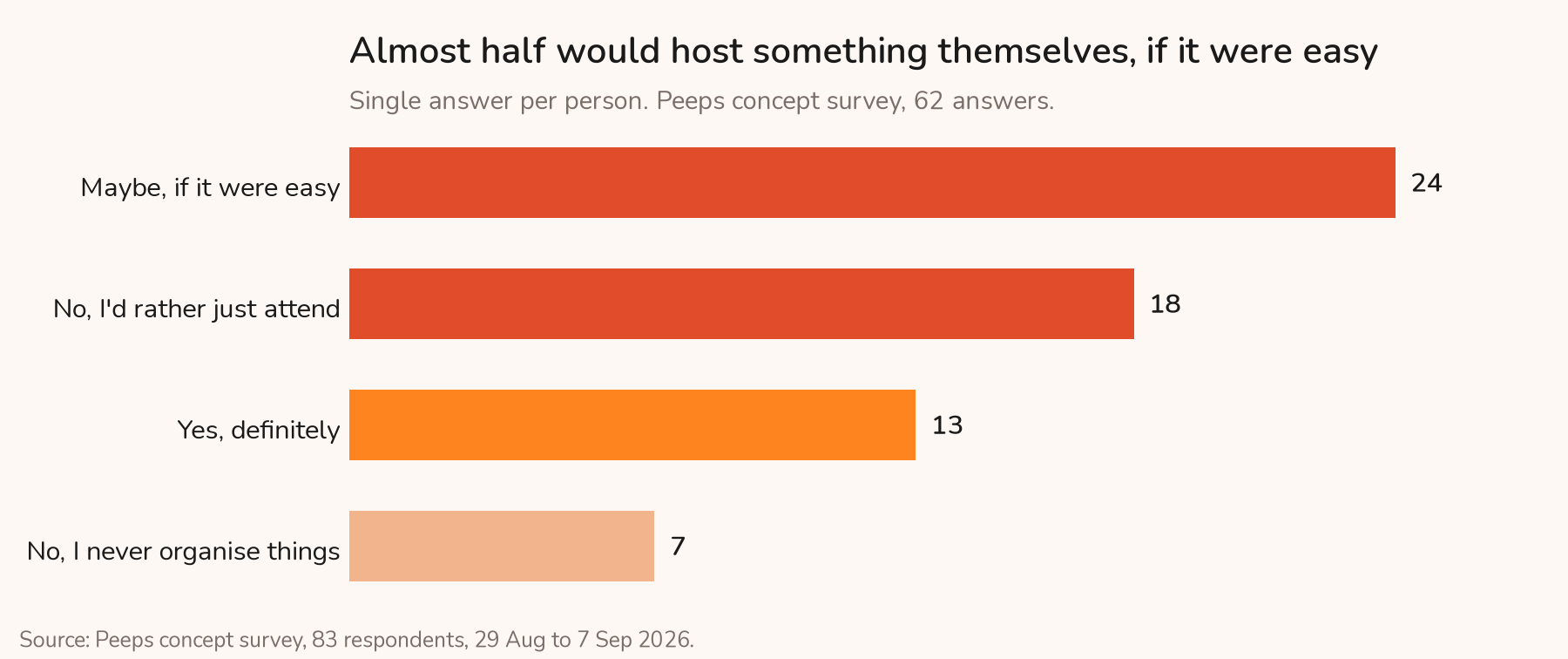
Thirteen people said yes, definitely, they would host. Twenty-four said they would if it were easy. Eighteen would rather just attend. Only seven said they never organise anything.
Read the conditional clause carefully, because it is the entire problem. "If it were easy" is not a personality statement. It is a complaint about work: chasing replies, guessing headcount, booking a table for a number you do not know, and then absorbing the no-shows personally.
Nobody wants to run a conference
When we asked what people would actually create, the answers were small.
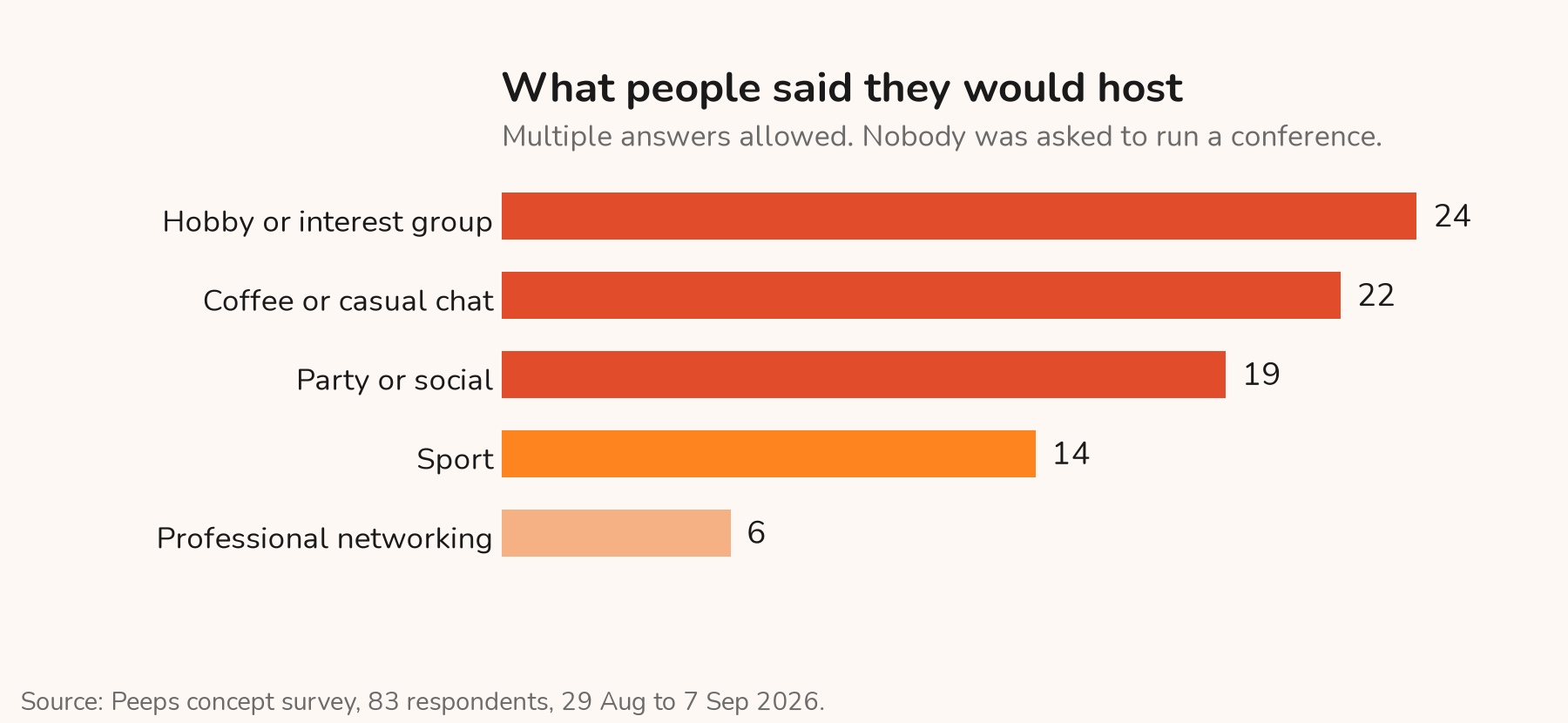
A hobby or interest group, 24. Coffee or a casual chat, 22. A party or social, 19. Sport, 14. Professional networking, 6.
Professional networking came last, which is worth remembering if you have been avoiding hosting because you pictured yourself running an event with a name badge table. What people want to go to is eight people who like the same thing, in a bar with chairs.
Why hosting is the cheapest fix for your own social life
The same survey shows why this matters for you personally, not just for your guests. When we asked what blocks people from meeting people they click with, 30 said they cannot find people with shared interests, 16 said there was no good setting or occasion, and 16 said shyness or not wanting to make the first move (the full breakdown is in our first article).
Hosting solves all three at once, which nothing else does.
The activity does the filtering, so shared interest is handled before anyone speaks. The occasion exists because you made it. And the shyness problem inverts: a host does not approach strangers, strangers approach the host. If you have ever stood at the edge of a room rehearsing an opening line, hosting is the loophole.
The format that works for a first attempt
Keep it embarrassingly small.
One activity, stated plainly. "Board games", "morning run in Łazienki", "coffee and talk about films". Not "social evening". A vague invitation makes people ask what it is, and asking is friction.
One venue with tables and normal noise levels. A bar or café you have already been to, where you know a group of six can sit. In Warsaw, places like Południk Zero, Ginnery, PiwPaw or any board game café already absorb this kind of group weekly. Do not book anything with a minimum spend for your first attempt. Do not put your own money at risk on a room.
One weekday evening, 18:30 to 19:00 start. Warsaw's working audience is hybrid now: the share of medium and large Polish firms allowing remote work has fallen from 71% in 2024 to 55% in 2026, with hybrid the standard (Grant Thornton). Practically that means office days are predictable, and people say yes to something 15 minutes from where they already are. An event on the far side of the city on a Tuesday will not fill, however good it is.
Six invitations, and let people bring one. Invite two friends, two acquaintances you like but barely know, and two people from a group or meetup you already attend. Tell all of them they can bring someone. Four turning up is a success. Three is fine. Two is a nice evening with two people.
One repeat date, announced on the night. This is the step that turns an event into a group. Before anyone leaves, say when the next one is. Same place, same weekday, four weeks later. Recognition is what converts acquaintances into friends, and recognition requires a second occasion.
The admin, and how to keep it small
The reason first-time hosts burn out is that they run the event on four platforms at once: an Instagram story, a WhatsApp group, a Facebook event, and a mental note. Pick one place for the guest list and one place for the conversation, and be strict about it.
A few things that reduce no-shows, all of them cheap:
- Send one reminder the morning of. Not three. One, with the address and the time.
- Cap the number and say the cap. "Table for eight" makes attendance feel like a slot rather than an option.
- Ask for a yes or a no, not a maybe. Maybes are the reason you booked for twelve and eleven came.
- Never front the bill. If the thing costs money, collect it before or let people pay for themselves at the bar. In this city, paid meetups tend to price around 35 PLN (Meetup), and a curated evening with a real format can carry more, but a first-time host should not be underwriting anything.
- Put a face on the invitation. Our survey's top requested feature overall, named by 34 of 83 people, was verified real people. Strangers decide whether to come based on whether the room looks real. A visible host is most of that.
What to expect the first three times
The first one will feel thin. Four people, an hour and forty minutes, one conversation you enjoyed. This is a normal result and not a verdict on you.
The second one is usually the same size but easier, because two people already know each other and the format has a precedent.
The third is where it changes. Someone brings a friend without being asked, somebody messages you about the date before you announce it, and you are no longer organising an event, you are maintaining a group. That is the point at which you stop waiting for invitations for the rest of your time in the city.
Warsaw is not short of attendees, by the way. InterNations lists more than 25,000 members in the city with 32 hosts producing around 19 events a month (InterNations), and Meet & Speak fills several free events a week (Meetup). The city has a demand surplus and a host shortage. Twenty-four "yes, if it were easy" answers in a survey of 83 people is the same shortage, measured from the other side.
The format matters more than the tool. Pick a Wednesday, pick a table, invite six people, and announce the next date before anyone goes home.
Based on the Peeps concept survey: 83 respondents, 58 completed, collected 29 August to 7 September 2026, largely in the Warsaw area. One city, small sample, recruited mostly through Instagram, so treat the numbers as a signal rather than a statistic.
Have a small meetup in mind?
Peeps lets you put it on the map, share one clear event page, and keep the guest list and conversation together.
Keep reading
How to make friends in a new city, according to 83 people who tried
Only 3 of 65 people blamed geography. What they lacked was a repeated occasion, and one small habit does more than any amount of messaging.
Why your chats never turn into meetings
Only 3 of 83 people blamed distance. What kills a promising thread is that nothing exists for it to arrive at.