
Why your chats never turn into meetings
Short version: the problem is almost never the conversation. It is that nothing exists for the conversation to arrive at. When we asked 83 people what breaks down, the answers all pointed at the same missing piece: a real occasion that repeats.
You have had this thread. It was good for four days. Voice notes, a shared opinion about a film, two "we should definitely do this". Then it thinned out, and neither of you was rude about it, and neither of you followed up.
We ran a survey between 29 August and 7 September 2026, mostly around Warsaw. Eighty-three people answered, 58 finished it, and the single most repeated failure in the whole dataset was this one.
Eighteen people said the hardest part of meeting someone new is that the chat fizzles before anyone meets. Eight said the conversation moves to WhatsApp or Instagram and dies there. Ten said they have never actually met anyone from an app at all.
Then, a few questions later, 32 people said that when they meet someone new they would rather move the conversation off the app to WhatsApp, Telegram or Instagram as soon as possible. Only 10 wanted to keep it where it started.
Read those together and the shape of the problem is clear. People name chat death as their main obstacle, and then move the chat to the place where chat death happens.
Moving to WhatsApp feels like progress, and is not
It is flattering. It is a small commitment that costs nothing. It produces the sensation of momentum without anyone having to name a Tuesday.
But a messaging thread has no built-in reason to continue. There is no next occasion in it, no third person who might mention you, nothing on a date. So it runs entirely on two people's willingness to keep generating energy from scratch, and the moment one of them has a bad week, the thread quietly closes.
Compare that with the way friendships actually formed for you before. Almost certainly at school, university, or a job. Not because those places had better people, but because they had a schedule. You saw the same faces, without arranging it, on a repeating basis, and familiarity did the work that no amount of messaging can do.
Our survey said the same thing from the other side. When we asked what blocks people from meeting someone they click with, 30 said they cannot find people who share their interests, 16 said there was no good setting or occasion, 16 said shyness or not making the first move, and only 3 said geography.
Three people out of 83 thought the problem was distance. The rest were describing a missing structure.
What people said they actually want
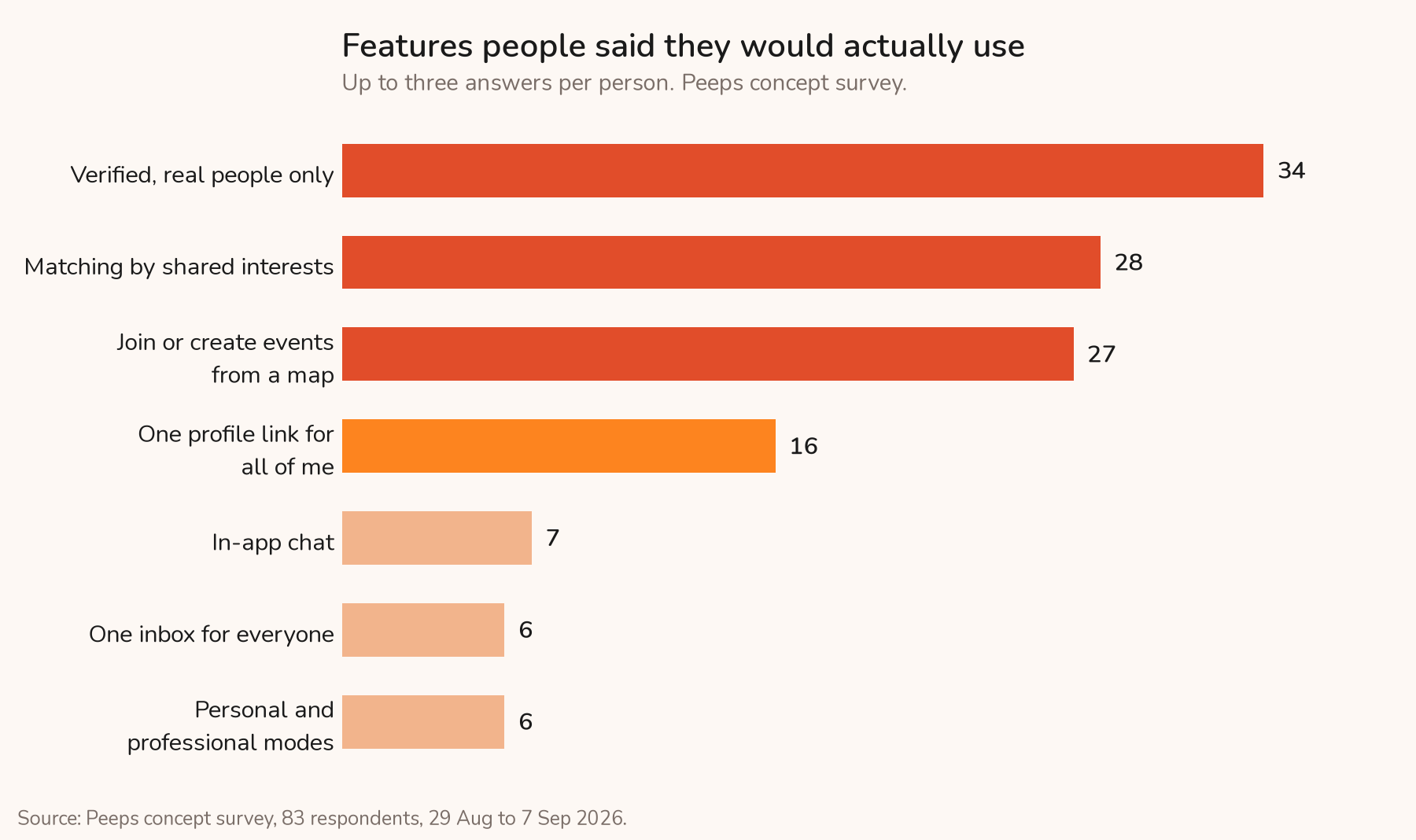
Verified real people came first, named 34 times. Matching by shared interests came second at 28. Creating or joining an event on a map nearby came third at 27. One profile link that holds everything got 16.
Nobody asked for a smarter algorithm. Nobody asked for a better inbox. The top three requests translate to one sentence: prove the strangers are real, show me the ones who like what I like, and give me somewhere to be this week.
That is not a feature list. It is a description of the missing structure.
The thing that fixes it is a repeat, not a reply
Here is the pattern that works, and it is almost boringly mechanical.
Something happens on a specific day, with an activity attached. The same people, roughly, come back to the next one. By the second occurrence somebody recognises you. By the third, someone brings a friend, and you no longer have to hold up any single conversation on your own, because the group is holding it.
This is why a weekly run, a monthly board game night, or a Thursday language exchange outperforms any thread. The recurrence is the relationship. Nobody has to be charming on demand.
It is also why hosting is such a good deal for a shy person. A host does not approach strangers, strangers approach the host. Twenty-four people in our survey said they would host something themselves if it were easy, and 13 said yes without conditions, against 7 who said they never organise anything. There is far more willingness to create occasions than the current tools make use of.
Where we sit in this, plainly
We built Peeps around that mechanism rather than around matching, so it is worth saying how the pieces fit, then you can judge whether it is useful to you.
An event goes on a map with a day, a time and a place, so the first thing that exists between two people is an occasion rather than a thread. If the event repeats, it keeps its group chat, which means the weekly runners or the Wednesday table are talking in the same place they meet, and that conversation has a reason to still be there next week. Anyone in that chat is a tap away from a real profile: photos, interests, the social links they already use, and a direct message if you want one. Someone who attends twice can create their own event, which is how an attendee turns into a host.
None of that is magic. It is just the school-timetable effect, rebuilt on purpose: a reason to meet, a group that persists between meetings, and enough context about people that a stranger stops being a stranger before you are standing in front of them.
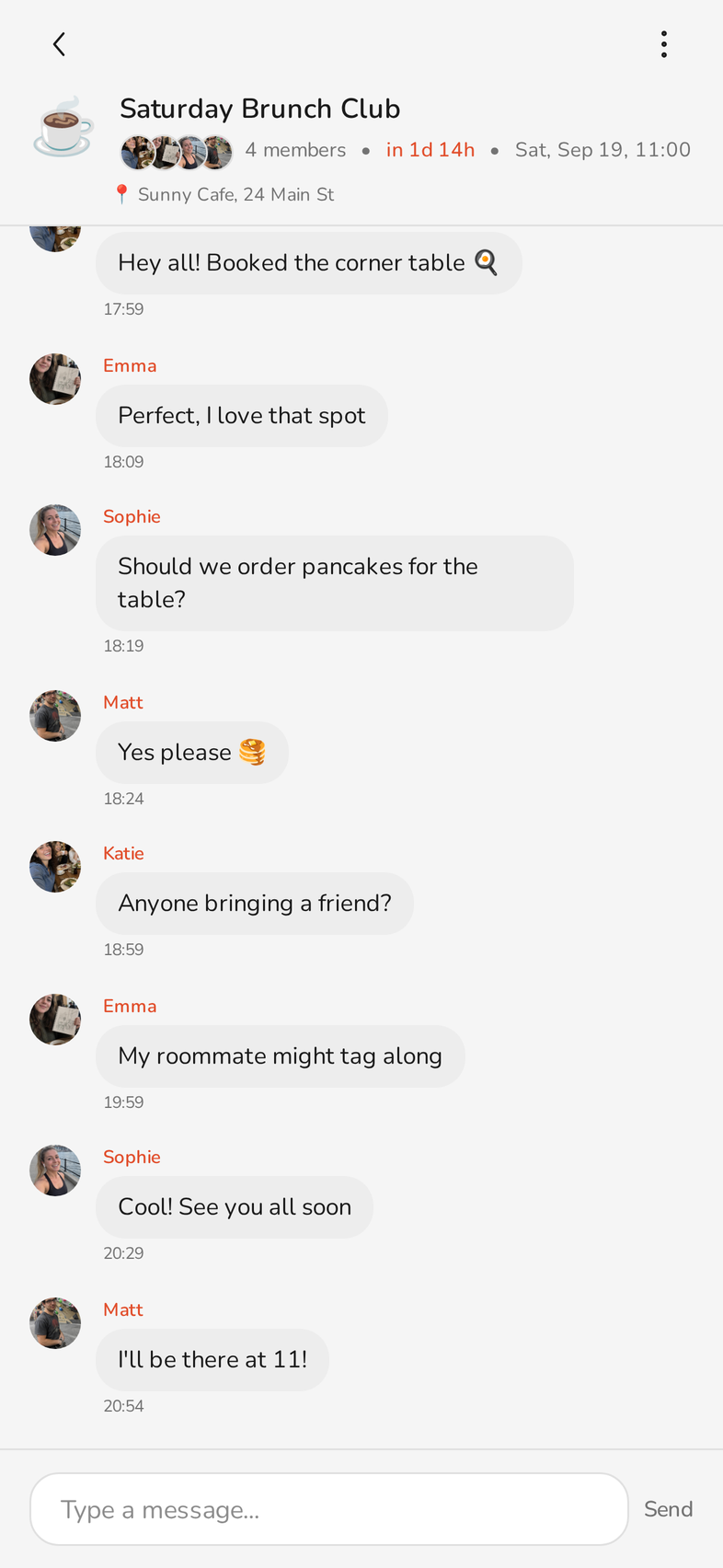
We are not trying to replace WhatsApp. People will always move a good conversation to WhatsApp, and that is fine once there is a Thursday behind it.
What to do this week, with or without us
- Put the plan before the migration. Before the thread moves to WhatsApp, name a place, a day and a time. "There's a tasting at Ginnery on Thursday at seven, I'm going." That sentence beats every feature ever shipped.
- Pick things that recur. A one-off event gives you an evening. A weekly one gives you a circle. In Warsaw the recurring free options are plentiful: InterNations lists more than 25,000 members and around 19 events a month (InterNations), and Meet & Speak runs several free events a week (Meetup).
- Go back a second time. This is the step nearly everyone skips. First visits are mediocre by design.
- If nothing near you repeats, host it. Six invitations, one table, one weekday, and announce the next date before anyone leaves.
People do not need another inbox. They need a reason to meet, and a way for that reason to repeat.
Based on the Peeps concept survey: 83 respondents, 58 completed, collected 29 August to 7 September 2026, largely in the Warsaw area. One city, a small sample recruited mostly through Instagram, so read the numbers as a signal rather than a national statistic.
Want the conversation to have somewhere to go?
Peeps starts with an occasion on the map, keeps the group chat between meetings, and puts real profiles and social links one tap away.
Keep reading
How to make friends in a new city, according to 83 people who tried
Only 3 of 65 people blamed geography. What they lacked was a repeated occasion, and one small habit does more than any amount of messaging.
Dating apps in Poland are quietly emptying out
One person out of 66 said they love dating apps. The complaints were never about who is on there, but about what happens after the match.