
How to make friends in a new city, according to 83 people who tried
Short version: the hard part is not meeting people, it is finding a reason to be in the same room as people you would actually like. We asked 83 people about this. Their answers point at one habit that works better than any amount of messaging.
You have been in the city for a few months. Work is fine. The flat is fine. You know the coffee place, the good tram, the shop that stays open late. And then Saturday arrives with nothing in it, and you notice you have not spoken to anyone who is not a colleague or a screen since Wednesday.
That gap is the thing nobody warns you about when you move. Between August and September 2026 we ran a survey about it. Eighty-three people answered, most of them in and around Warsaw, most of them somewhere between 25 and 38, and 58 of them went all the way to the end. What they said does not match the usual advice.
People are not the problem. Occasions are
Here is the answer that reframed everything for us. We asked what actually gets in the way of meeting people you click with.
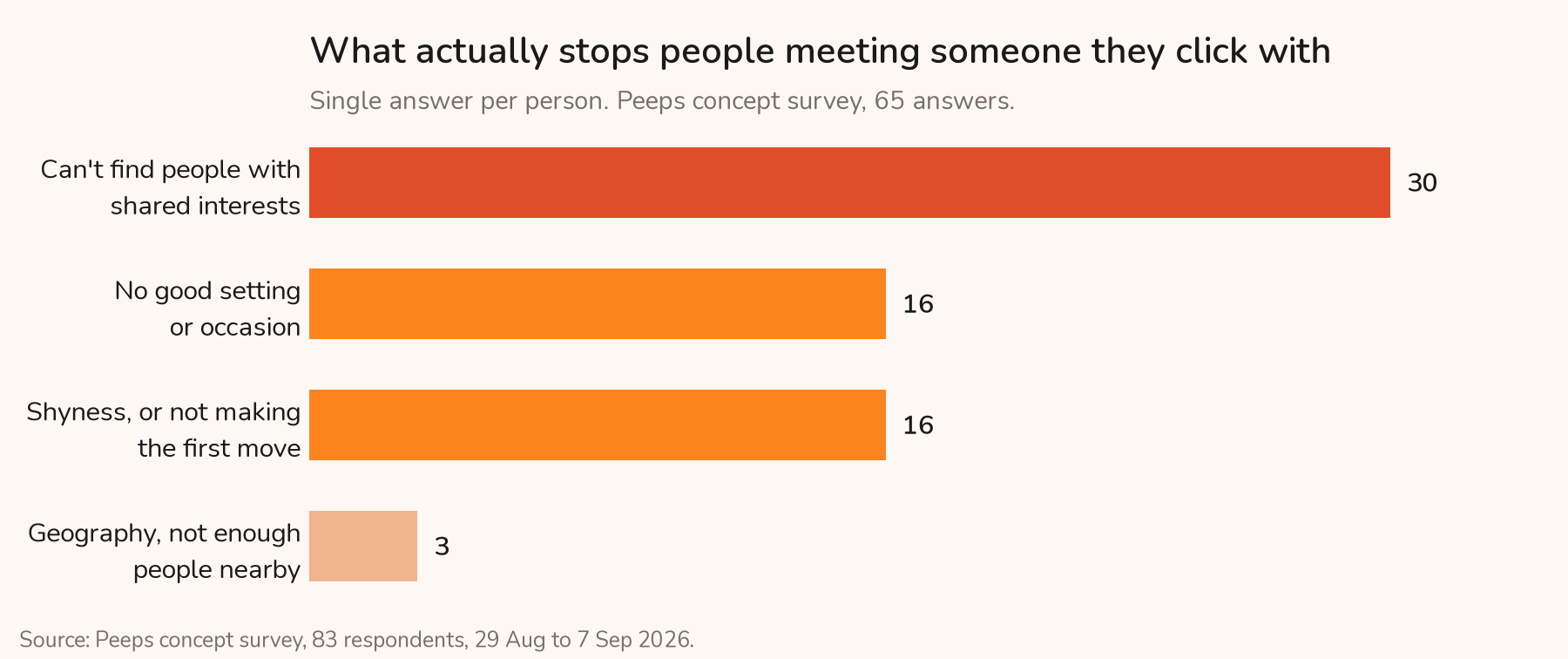
Thirty people said they cannot find people who share their interests. Sixteen said there was no good setting or occasion. Sixteen said shyness, or not wanting to make the first move. Three people said geography.
Three. In a city with more than two million people in it on any given day, according to Poland's statistics office and its experimental count of who is actually present in Warsaw (GUS, reported by Notes from Poland), almost nobody thinks the problem is a shortage of humans.
So the loneliness of a new city is not really about density. It is about the absence of a repeated occasion where the same faces show up. You have that at work by accident. You do not have it anywhere else, and no amount of scrolling manufactures one.
The apps you already have are not going to do this
Almost everyone who answered had the apps. Very few were still using them with any hope.
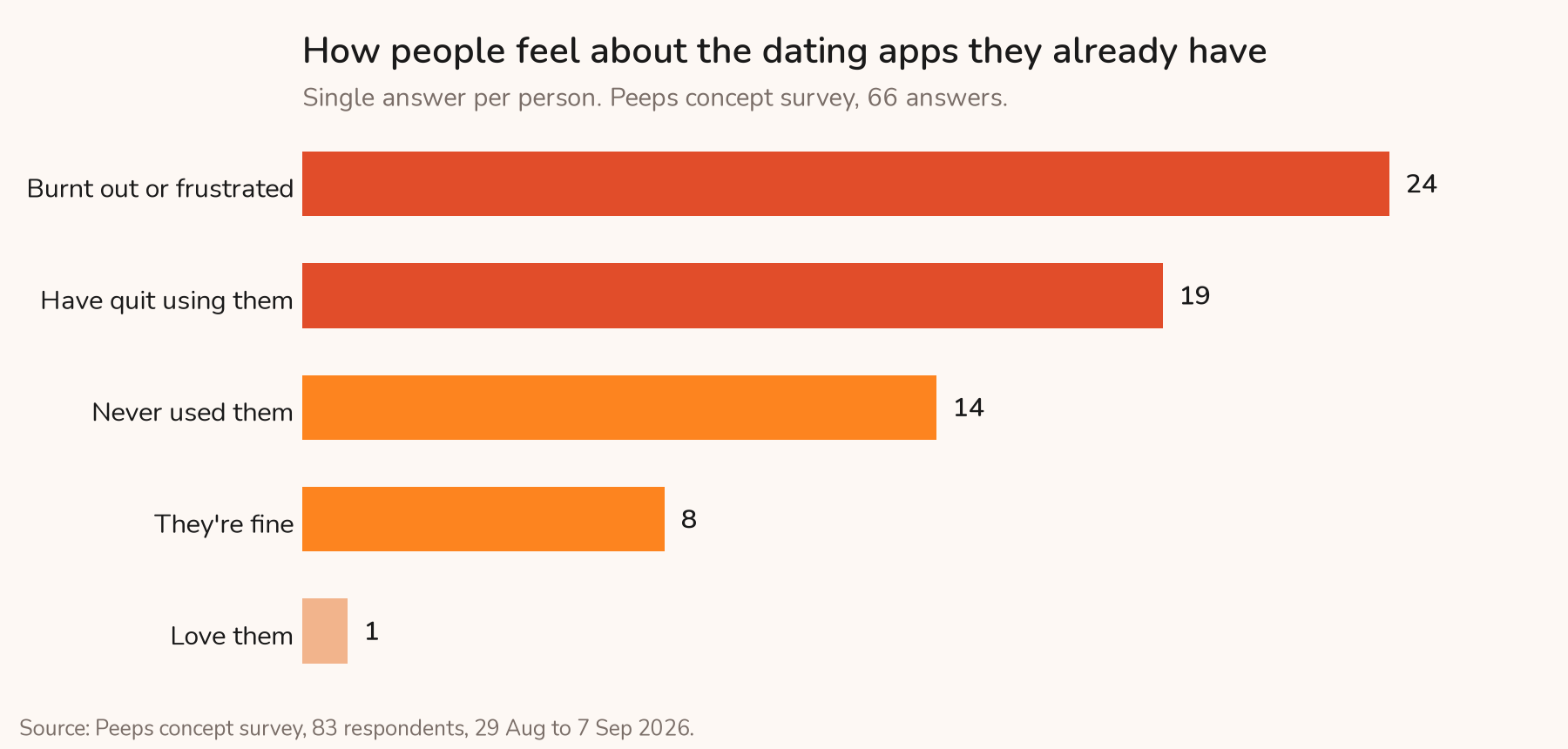
Twenty-four people described themselves as burnt out or frustrated. Nineteen had quit. Exactly one person out of 66 said they love them. Among the burnt out and the quitters, endless swiping came up 31 times, ghosting 21 times, and "too superficial" 14 times.
This is not a local mood. Time spent in dating apps in Poland has fallen off a cliff: average monthly time in Tinder and Badoo dropped from roughly 73 minutes in early 2023 to about 19 minutes by early 2024 (VVA, Spisy Mobile). The apps are still installed. People just stopped opening them.
Worth saying plainly, because it saves you months: if you moved somewhere new and your plan is a dating app, you have picked a tool built to produce matches, not friendships. Twenty-seven people in our survey named "hard to turn matches into real meetups" as their main frustration with the apps they use.
The part where it fizzles
We asked what the hardest part of meeting someone from an app actually is. The most common answer, from 18 people, was that the chat fizzles before anyone meets in person. Another 8 said the conversation moves to WhatsApp or Instagram and quietly dies there. Nine said there was no shared activity to meet at.
And then the contradiction, which is my favourite thing in the whole dataset: 32 people said they would rather move a new conversation off the app to WhatsApp, Telegram or Instagram as soon as possible. The same people who complain that chats fizzle are the people who want to relocate the chat to the place where it fizzles.
I do not think they are being irrational. Moving to WhatsApp feels like progress. It is a small commitment, it costs nothing, and it produces the sensation of momentum without the risk of asking for a specific Tuesday. Then Tuesday never gets asked about, and three weeks later neither of you remembers who stopped replying.
The one habit that works
Propose something specific, early, and small.
Not "we should hang out sometime". A place, a day, a time, and a reason. "There's a language exchange at 7 on Thursday, I'm going, come along." "I'm walking around Łazienki on Sunday morning if you want to join."
This works for three reasons the survey makes obvious. It answers the shared-interest problem, because the activity does the filtering for you. It removes the first-move problem, because you are inviting someone to a thing rather than asking them to like you. And it defeats the fizzle, because there is now a date and a place, and dates and places create obligation in a way that friendly messages never do.
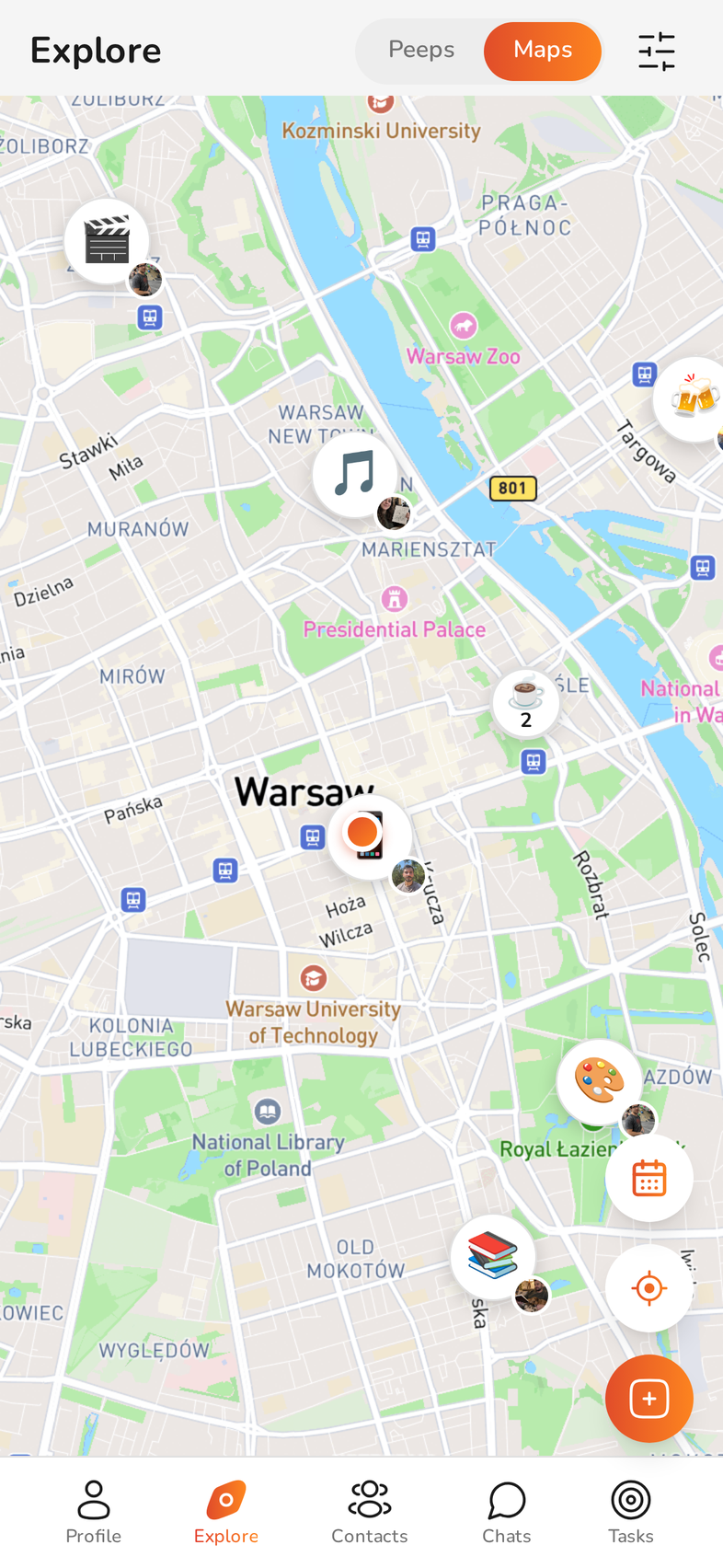
The bar is lower than you think. When we asked what people would want from a platform like ours, the answers were not clever features. Verified, real people came first, mentioned 34 times. Matching by shared interests came second at 28. Being able to see or create an event on a map near you came third at 27.
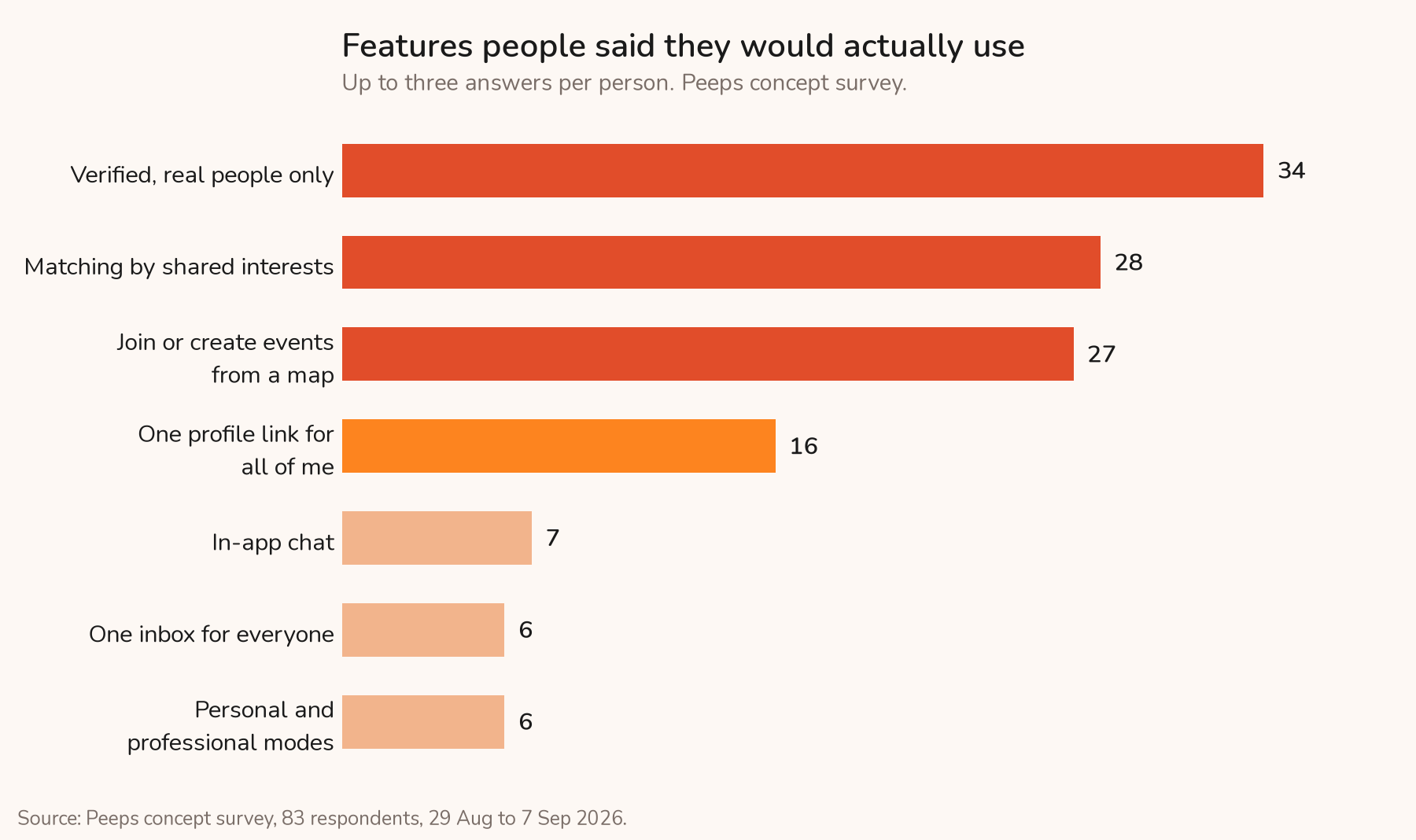
Read that as a description of what a person new to a city actually wants: proof that the strangers are real, a way to find the ones who like the same things, and something happening nearby this week.
Start with what already exists, and go twice
Before you invent anything, use the infrastructure the city already has. In Warsaw, InterNations lists more than 25,000 members and around 19 events a month (InterNations Warsaw). Meet & Speak runs several free events a week, including a Saturday gathering that regularly pulls a couple of hundred people (Meetup). Warsaw International has thousands of members (Meetup). Most of this costs nothing. Semrush's data shows people search for exactly this too, with "warsaw meetup" at roughly 170 searches a month.
The rule that matters: go to the same thing twice. A first visit to a group event is almost always mediocre. You talk to two people, you forget both names, you leave early and conclude it did not work. The second visit is when someone recognises you, and recognition is the entire mechanism by which acquaintances become friends. Almost everyone quits after the first visit and blames the city.
And then host something yourself, badly
This was the most unexpected result in the survey. We assumed most people want to attend and only a rare few want to organise. Wrong.
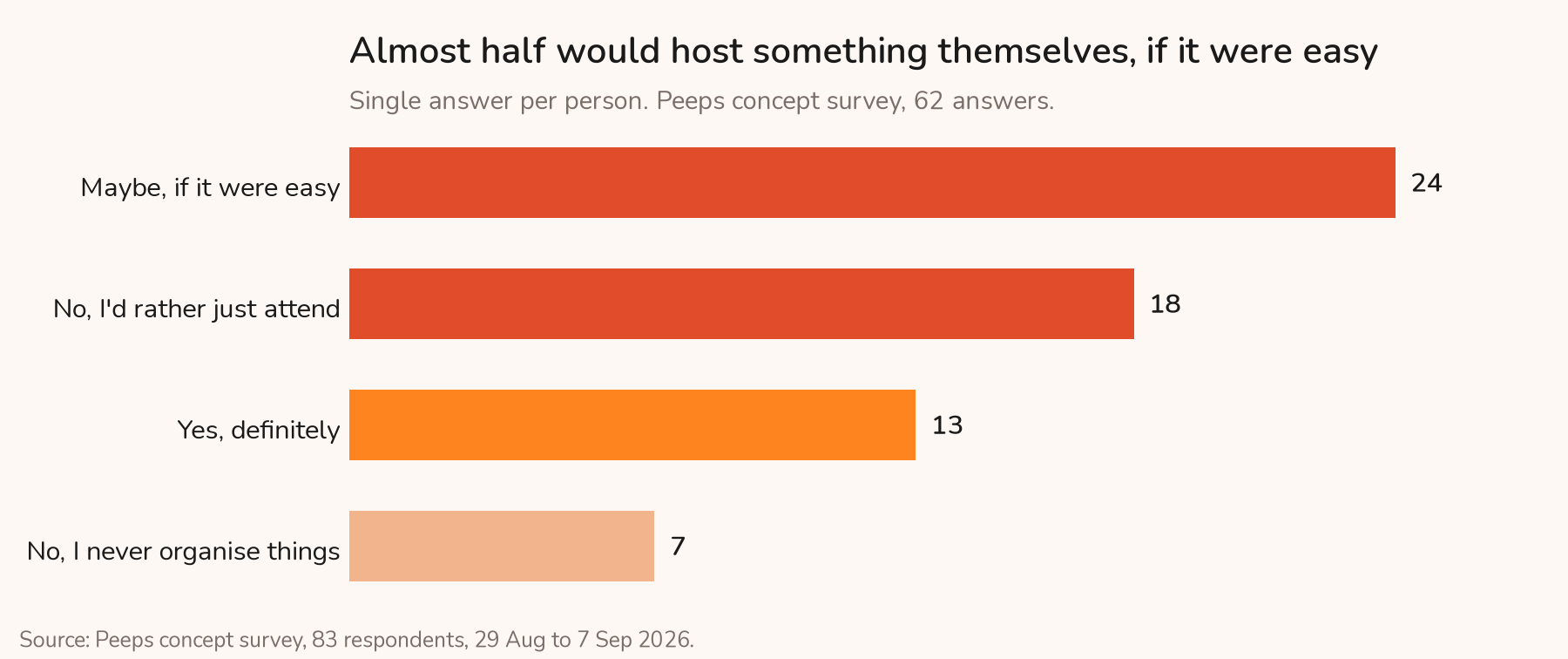
Twenty-four people said they would host their own meetup if it were easy. Thirteen said yes, definitely. Only 7 said they never organise anything. Asked what they would host, the answers were modest: a hobby or interest group (24), coffee or a casual chat (22), a party (19), sport (14).
Hosting sounds like it requires authority you do not have in a new city. It does not. Pick a bar with tables, pick a Wednesday at seven, invite six people including two you barely know, and let them bring someone. Four turning up is a success. You have just built the repeated occasion that the entire survey says is missing, and you now own it, which means you never have to wait for an invitation again.
Being the person who organises is also the fastest shortcut out of the shyness trap. Sixteen people named shyness as their blocker. A host does not have to introduce themselves to strangers. Strangers introduce themselves to the host.
What to do this week
- Find one recurring free event in your city that matches something you already like, and put it in your calendar twice, not once.
- When you meet someone you get on with, propose a specific plan before you swap numbers, not after.
- Set a date three weeks out and host something tiny. Six invitations, one table, no theme required.
- Stop treating the dating apps as a social plan. Nineteen people in our survey quit them and were noticeably not worse off.
None of that requires you to become an extrovert. It requires you to create occasions instead of waiting for them, which is a scheduling skill, not a personality.
This article draws on the Peeps concept survey: 83 respondents, 58 completed, collected 29 August to 7 September 2026, largely in the Warsaw area. It is a small sample from one city, so treat the numbers as a strong signal rather than a national statistic. Peeps is a link-in-bio profile and social app that helps people find others nearby with shared interests and meet them at real events. You can see it at peeps.bio.
Want the occasions, not the swiping?
Peeps shows you people nearby who share your interests, and the events they are actually going to. One link holds all your socials too.