
Dating apps in Poland are quietly emptying out
Short version: people did not delete the apps. They stopped opening them. We asked 83 people about it, and the reasons they gave line up almost exactly with what the national usage data shows.
Somebody in your office still has Tinder installed. So do you, probably. Neither of you has opened it since the spring.
That is roughly the state of dating apps in Poland right now. Not a dramatic exit, more a slow loss of interest that nobody announced. We ran a survey between 29 August and 7 September 2026, mostly in and around Warsaw. Eighty-three people answered, 58 finished it, and the section about dating apps produced the bleakest numbers in the whole dataset.
One person out of 66 said they love them
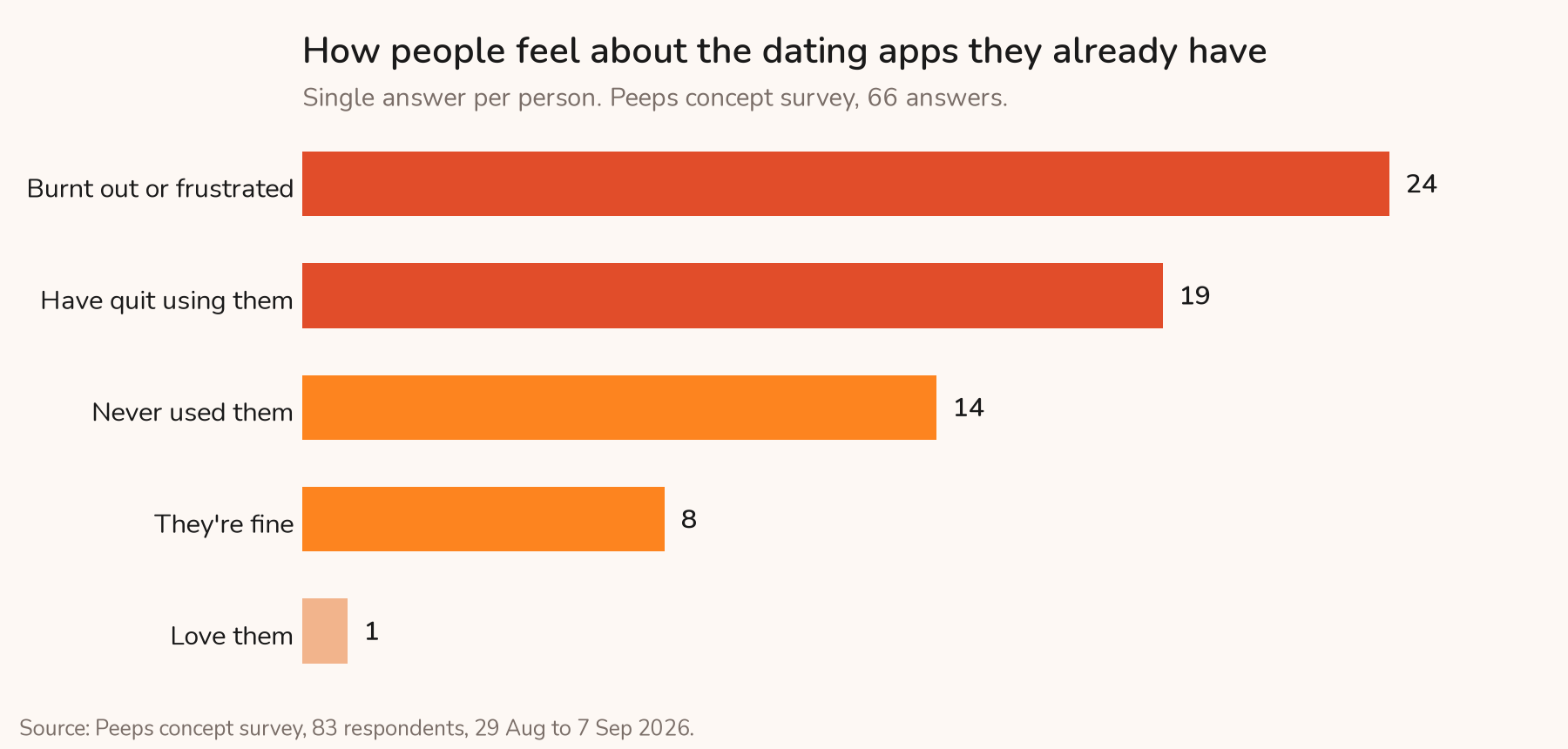
Twenty-four people called themselves burnt out or frustrated. Nineteen had quit. Fourteen had never bothered. Eight said the apps were fine. One person said they love them.
That is 43 people out of 66 who are actively negative about a product they own and could open tonight.
The national picture agrees. Average monthly time spent in Tinder and Badoo in Poland fell from about 73 minutes in February 2023 to roughly 19 minutes by January 2024 (VVA, Spisy Mobile). Tinder still has something like 830,000 weekly active users in Poland, so the audience has not gone anywhere (Sensor Tower). What has gone is the time. An app that used to get an hour of your month now gets a quarter of that.
What actually caused it
We asked the people who quit or burnt out what did it. They could pick more than one reason.
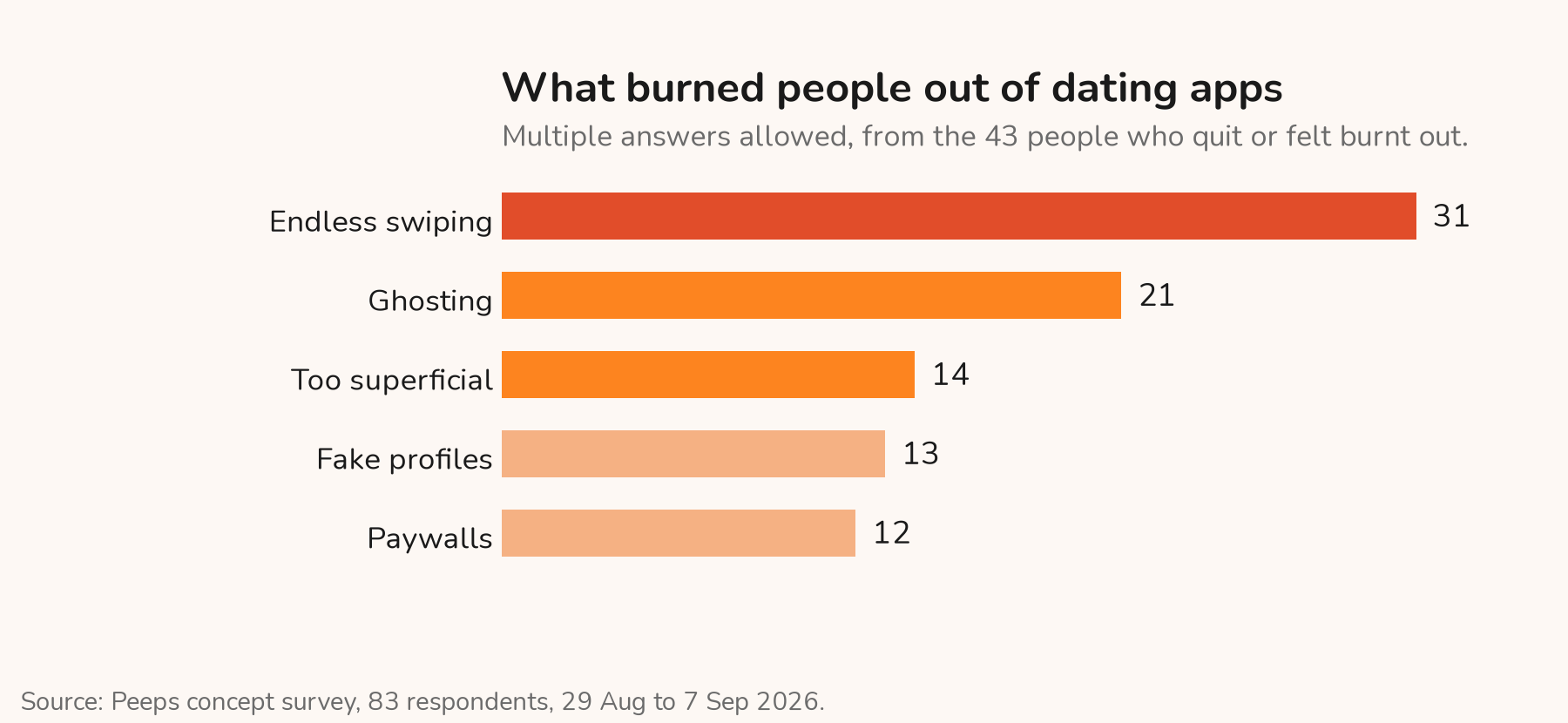
Endless swiping came up 31 times. Ghosting 21. Too superficial 14. Fake profiles 13. Paywalls 12.
Notice what is missing from that list. Nobody said there were no attractive people. Nobody said the algorithm was bad at guessing their type. The complaints are all about the shape of the thing: a repetitive input, an unreliable output, and a bill.
There is a gender problem sitting underneath this too. Polish dating platforms run at roughly 62 to 65% male visitors (VVA). Our own survey traffic came in at 33 men to 13 women. When two thirds of a room is one gender, the experience for that two thirds is mostly waiting, and waiting is what people describe when they say burnout.
The failure point is not matching. It is the week after
This is the part I keep going back to. We asked what the hardest part of meeting someone from an app is.
Eighteen people said the chat fizzles before anyone meets in person. Ten said safety concerns. Ten said they have simply never met anyone from an app. Nine said there was no shared activity to meet at. Eight said the conversation moves to WhatsApp or Instagram and dies there.
Then, a few questions later, 32 people said that when they meet someone new they would rather move the conversation off the app to WhatsApp, Telegram or Instagram as soon as possible. Only 10 wanted to stay in-app.
So the same population that names chat death as its main obstacle also wants to move the chat to the place where it dies. That is not stupidity. Moving to WhatsApp feels like progress. It is cheap, it is flattering, and it produces the sensation of momentum without anyone having to ask for a specific Tuesday. Then no Tuesday gets asked about.
The apps are optimised for the part people find easy, which is getting a match, and they hand over the part people find hard, which is converting a conversation into a plan, at exactly the moment it becomes hard.
Why "I'll just take a break" does not fix it
Twenty-seven people in the survey named "hard to turn matches into real meetups" as their frustration, and 32 said the whole experience feels shallow. Those are not complaints about volume. Deleting the app for two months and reinstalling it does not change either of them, which is why the reinstall cycle is so familiar: a dull weekend, three days of swiping, two conversations, nothing, uninstall.
Meanwhile the underlying loneliness is not imaginary. A national study from Wrocław Medical University found 68% of Polish adults report feeling lonely, with about half showing chronic hidden loneliness, and 18 to 35 year olds among the most affected (RMF24). CBOS adds a useful correction: young Poles are not socially empty, since 65% see friends at least a few times a month, and among single people 35% are looking for a serious relationship while 32% are not looking at all (CBOS 57/2025).
Read those two together and you get the real situation. Most people are not starved of humans. They are short of good occasions with the right humans, and a swipe feed is a poor substitute for one.
What people said they would use instead
We asked what would make a platform worth their time. The answers were unglamorous.
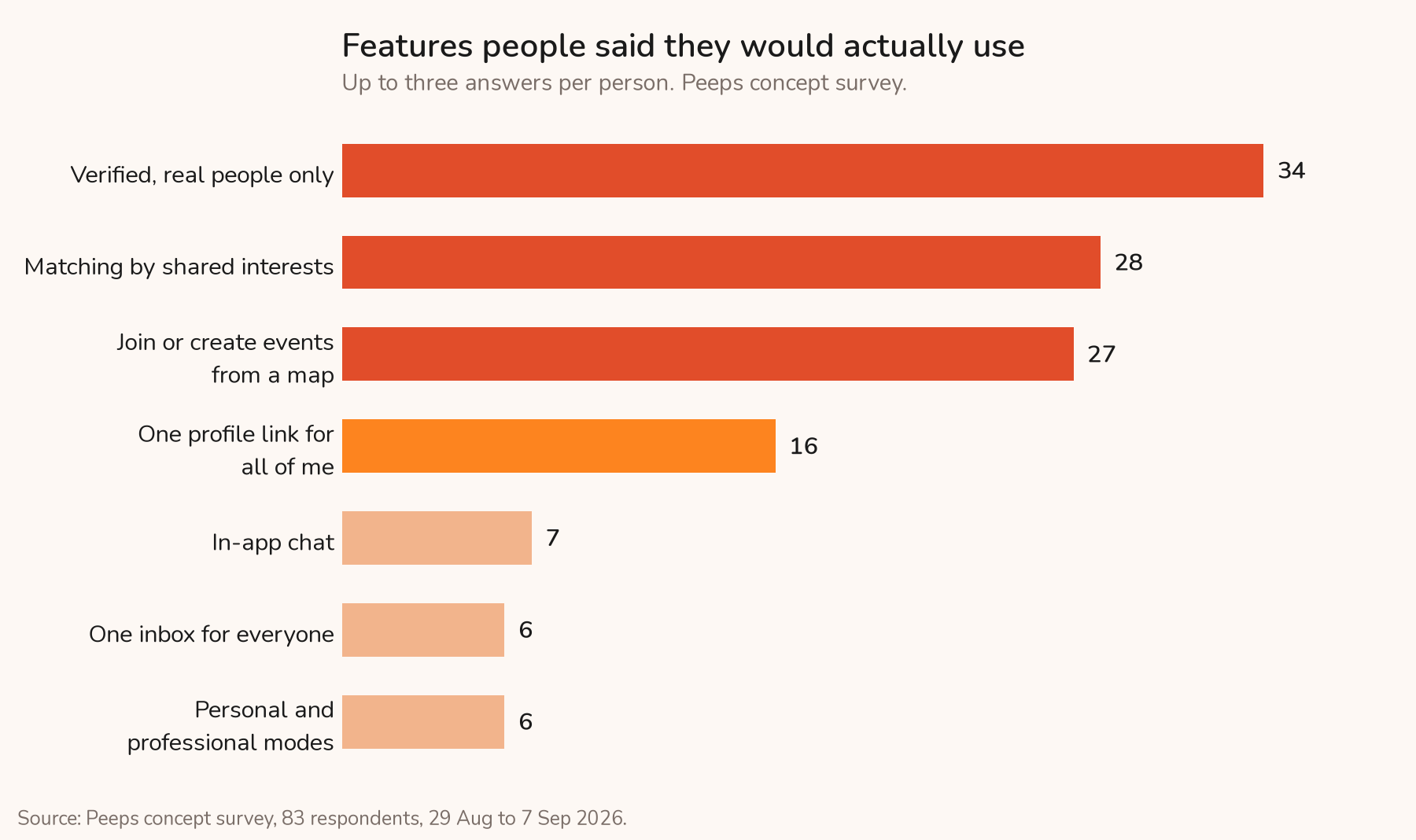
Verified real people came first, named 34 times. Matching by shared interests came second at 28. Creating or joining an event on a map nearby came third at 27. One profile link that holds everything got 16. A single inbox got 6. A personal and professional mode switch got 6.
The top three are one sentence: prove the strangers are real, show me the ones who like what I like, and give me somewhere to be this week. Nobody asked for a cleverer algorithm.
If you want out of the loop, do this instead
- Stop treating a dating app as your social plan. It is a tool for producing matches. It was never built to produce a Thursday.
- Go where there is an activity attached. In Warsaw the free infrastructure already exists: InterNations lists more than 25,000 members and around 19 events a month (InterNations Warsaw), and Meet & Speak runs several free events a week (Meetup). Paid meetups in this scene tend to sit around 35 PLN, which is the going rate for an evening with a format.
- Propose the plan before the chat migrates. A place, a day, a time. "There's a tasting at Ginnery on Thursday at seven, I'm going." That single sentence solves the fizzle problem better than any feature.
- Repeat one thing. The second visit to the same group is where somebody recognises you, and recognition is the whole mechanism. Most people go once, talk to two strangers, leave early and blame the city.
- Pay for occasions, not for access. Twelve people named paywalls as a burnout cause. A ticket to a thing that exists is fine. A monthly fee to look at faces is what soured everyone in the first place.
Dating apps in Poland are not dying because the technology got worse. They are being outcompeted by anything that puts a real activity on a real date, and that has been available to you the entire time.
Based on the Peeps concept survey: 83 respondents, 58 completed, collected 29 August to 7 September 2026, largely in the Warsaw area. It is a small, Instagram-recruited sample from one city, so read the numbers as a strong signal rather than a national statistic.
Want the occasion, not another match?
Peeps helps you find verified people nearby through shared interests and real events, so a conversation has somewhere to go.
Keep reading
Why your chats never turn into meetings
Only 3 of 83 people blamed distance. What kills a promising thread is that nothing exists for it to arrive at.
How to host your first meetup when you have never hosted anything
24 people said they would host if it were easy. The blocker is not confidence, it is admin. Six invitations, one table, one Wednesday.